
Book review of J.B. Fressoz (2024). More and More and More. An All-Consuming History of Energy, Penguin Random House, 400 pp. For a Dutch translation of this review see here.
Dr. G.J. van Bussel
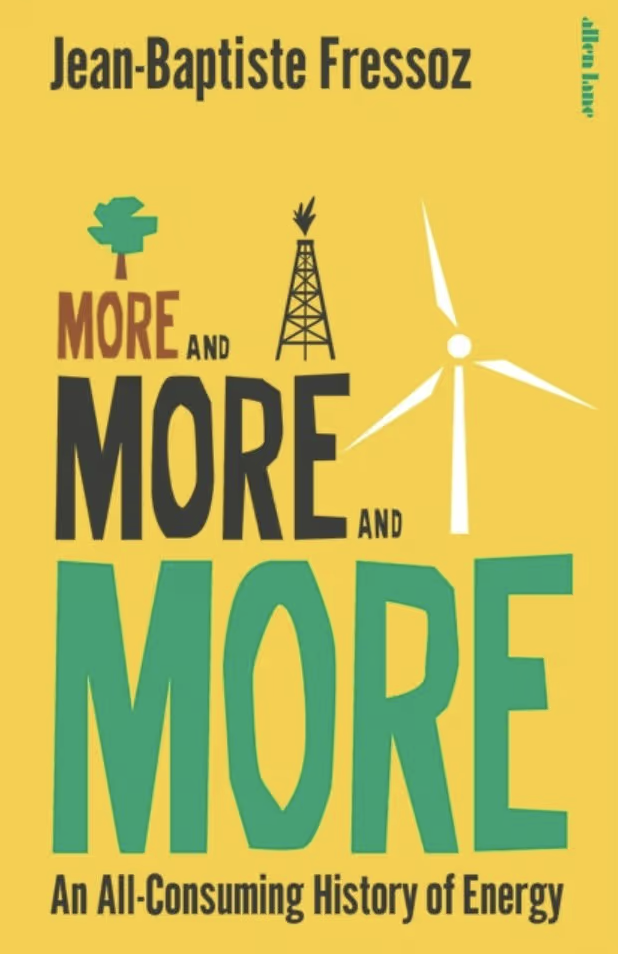
The focus on energy, and the attached corporate and governmental agendas, has exerted a large influence upon the social sciences. Although political ecology maintains a stance of hostility towards the claims of sustainable development, [1] it has acquiesced to the proposition of an energy transition and the concepts associated with it: ‘green’, ‘clean’, and ‘renewable’ energy. [2] This narrative of transition combines the profit-driven aspirations of green capitalism with a pacification of existing climate anxieties. It is for this reason that reading Jean-Baptiste Fressoz’s new book More and More and More. An All-Consuming History of Energy, is a ‘must’.
Fressoz, a historian at the French National Centre for Scientific Research (CNRS) and Professor at the École des Ponts ParisTech, examines the historical dynamics between humanity and its environment. His work challenges conventional narratives of industrial progress and ecological awareness. In his monograph, Happy Apocalypse. A History of Technological Risk (2024), Fressoz puts forward the provocative idea that environmental and industrial regulations, introduced from the early nineteenth century onwards, were rarely designed to reduce environmental degradation or protect workers. Instead, he argues that their main purpose was to legalize these dangers, thereby creating a legal framework that allowed industrialists to pursue profit. Fressoz suggests that this process of legal normalization systematically externalized the costs of industrialization onto society and the natural world.
In The Shock of the Anthropocene. The Earth, History and Us (2017), co-authored with Christophe Bonneuil, he challenged the notion that the ecological consequences of industrial activity were discovered only recently. Fressoz demonstrates that industrializing societies possessed a long-standing and sophisticated understanding of their own destructive potential. Through his books and his monthly column in Le Monde, Fressoz reveals that our ecological situation is not the result of sudden failure or lack of knowledge, but rather the logical outcome of political and economic choices that have prioritized expansion and accumulation over sustainability and precaution.
More and More and More has sparked significant debate within the field of political ecology by presenting a rigorously documented challenge to the conventional narrative of energy history. Fressoz systematically deconstructs the prevailing thesis of energy substitution — the smooth, linear narrative of a natural progression from wood to coal to oil and, eventually, to renewables. He argues that this view is illusory and instead presents a compelling argument for a historical logic of accumulation. Rather than replacing older sources of energy, each new form, from coal onwards, has been added to the existing mix. This has created a symbiosis of energy sources and led to insatiable energy demand. He demonstrates “why all primary energies have grown together and why they have accumulated without replacing each other” (p. 2).
According to Fressoz, this historical reality underpins his second, more polemical thesis: a devastating critique of the concept of energy transition. Fressoz reveals this narrative to be an ideological construct originally promoted by nuclear energy companies, not as a plan for change, but as a strategy to delay meaningful action. By presenting the shift from fossil fuels as an unavoidable consequence of technological progress, the transition narrative encourages a dangerous wait-and-see approach. This, in turn, creates a political inertia that maintains the dominance of the fossil-fuel status quo. He argues compellingly on this point: “Transition is the ideology of capital in the twenty-first century. It turns evil into cure, polluting industries into the green industries of the future, and innovation into our lifeline. Transition puts capital on the right side of the climate battle. Thanks to transition, we are talking about trajectories to 2100, electric cars and hydrogen-powered aircraft rather than material consumption levels and distribution. Very complex solutions in the future make it impossible to do simple things now” (p. 220).
This critique returns us to a central argument of Fressoz’s earlier work, Happy Apocalypse: that societies have been locked into pathways of escalating consumption by deliberate political and economic choices, not merely by technological necessity. From this analysis follows his radical conclusion, introduced early in the volume, which advocates for energy amputation: “The climate imperative does not call for a new energy transition, but it does require us to voluntarily carry out an enormous energy amputation: to get rid, in four decades, of the proportion of the world’s energy – more than three-quarters – derived from fossil fuels” (p. 13).
In the first part of his work (Chapters 1–8), Fressoz dismantles conventional energy history to advance what he terms a “new apprehension of the dynamics of energy and materials.” (p. 14) His central thesis is that our modern world was built not through a series of clean breaks, but through a process of relentless accumulation, where new energy sources layer upon and depend on the old.
He begins with a surprising but revealing case study: the candle. In Chapter 1, he traces its evolution not as a story of obsolescence, but of synergy. The technologies of the industrial age led to the production of stearin and paraffin wax as by-products, which fuelled a massive expansion of candle manufacturing. This demonstrates Fressoz’s core principle: innovation rarely replaces; it more often creates new demand, leading to an overall increase in consumption and production. From this case study, Fressoz moves to a macro-level critique in Chapter 2, systematically debunking the popular concept of successive ‘ages’ (the Age of Steam, the Age of Oil, the Solar Age.) He dismisses these as unsubstantiated marketing phrases that obscure a messy reality. He argues that this staged-history framework has long served as an alibi, a comforting narrative that allows societies to ignore inconvenient data pointing to the persistent and growing use of ‘outdated’ resources.
Chapters 3 through 5 illustrate his alternative model: a history of stratification and symbiosis. Here, Fressoz demonstrates that the rise of coal was not a transition away from wood but was entirely dependent on it. He presents expansive data showing that Europe’s coal mines were built with vast quantities of wooden pit props, and that the steam engines, steel, and railways of the industrial revolution were fundamentally underwritten by timber. He extends this logic to oil, arguing that its extraction was made possible only by immense inputs of coal, wood, and human labour, creating a symbiotic chain of energy dependence. This commitment to a more accurate material history leads him, in Chapter 6, to a strong critique of Timothy Mitchell’s influential Carbon Democracy. [3] Fressoz identifies several critical flaws: Mitchell compares the political structures of the oil industry at its maturity to those of the coal industry in its earlier, more volatile phase, creating a distorted picture. He also, according to Fressoz, overlooks the fact that the international coal trade was still larger than oil in the 1950s, and mistakenly relies on an energy transition thesis that the data itself contradicts.
The argument reaches its culmination in Chapters 7 and 8, which details the astonishing, ongoing omnipresence of wood within our modern fossil-fuelled civilization. Fressoz shows that wood was not merely a relic but a critical component in the production of steel and oil, and especially in the global logistical infrastructure that enables modern trade. He goes further, revealing how the hybridization of wood with petrochemicals created new materials like plywood and pallets, which in turn revolutionized shipping and urban planning. This symbiosis has become so profound that the roles have reversed: modern forestry now runs on oil. As Fressoz concludes, with “two to three litres of diesel consumed per cubic metre of wood extracted, wood has become a fossil fuel in part” (p. 119.) His ultimate conclusion from this entire section is that contrary to the dominant narrative, “there has never been an energy transition out of wood” (p. 125.)
Chapters 9 through 12 form the intellectual core of Fressoz’s critical history, tracing in detail how the concept of an energy transition was not a natural discovery but a constructed narrative. He argues that its origins lie not in ecological concern, but in a modern, technocratic ideal of societal control. Chapter 9 locates this genesis in early 20th-century movements, like the Technocracy movement in the United States. These groups, obsessed with efficiency and central planning, were the first to conceptualize energy change as a managed, sequential procession through distinct technological ‘ages’ all directed by a class of expert engineers. This abstract idea of orderly progression was then granted scientific authority through the adoption of the logistic curve, or S-curve. This mathematical model proved seductive; it visualized the adoption of a new energy source as an inevitable, self-contained process: a period of rapid growth, a smooth inflection point, and a final plateau at market saturation. This model provided a deceptive but powerful blueprint, suggesting that energy systems transition through a natural, predictable lifecycle where the new seamlessly displaces the old.
According to Fressoz, this clean, abstract model was then strategically weaponized. In Chapters 10-12, he details how the transition narrative was championed by advocates of atomic energy in the post-war era. Confronting rising fears of resource collapse, these proponents offered a solution: the problem was not overconsumption, but merely the type of fuel. Using the S-curve as their guide, they argued for a technological swap (oil for atoms) positioning nuclear power as the next inevitable step on the pre-ordained path. This was a transition conceived with a specific, conservative goal: to preserve and extend the life of high-energy industrial civilization, not to question or transform its foundational logic. Crucially, Fressoz reveals that the S-curve model was not just simplistic but fundamentally deceptive. Its fatal flaw was its one-sided focus on the diffusion of new technologies while systematically ignoring the political economy of phase-out. It portrayed the decline of fossil fuels as a passive, automatic byproduct of progress, rather than an active and contested process that must be forced through regulation and policy.
Fressoz’s conclusion is that the narrative’s success lies precisely in this flaw. By promising a painless, technological pathway, the energy transition became a powerful ideological tool. It comfortably aligned the interests of governments, fossil fuel companies, and a public unwilling to sacrifice, offering a vision of salvation that required no systemic change, no reduction in consumption, and no challenge to the growth paradigm. It created a politics of procrastination, allowing for the continued accumulation and use of all energy sources while deferring genuine decarbonization to an ever-receding, mythical technological future.
Fressoz offers a powerful rebuttal to mainstream climate solutions. He argues that the promise of a seamless energy transition, powered by solar panels, wind turbines, and smart grids, is a dangerous fantasy that enables delay. By examining the relentless growth in plastics, cement, and mining, he demonstrates that green technology alone cannot solve a crisis driven by overconsumption. His conclusion is unequivocal: averting disaster requires a fundamental shift away from growth itself, demanding a deliberate degrowth of our economies.
The importance of More and More and More lies in its radical reinterpretation of the historical lens through which we view the climate crisis. Fressoz provides a well-researched critique that challenges the complacent idea that an energy transition will naturally solve the problem, thereby dismantling a core assumption of modern environmental and economic policy. By replacing the concept of transition with those of accumulation and symbiosis, Fressoz highlights a difficult truth: new technologies have historically enabled greater energy and material consumption, not less. This perspective portrays true decarbonization as an unprecedented historical endeavour that ultimately necessitates an ‘amputation’ of the material world.
Fressoz’s work is a masterclass in historical methodology, meticulously deconstructing the self-serving myth of the energy transition. Through a detailed genealogy of the concept, he reveals that this narrative is not a historical fact, but rather an ideological tool designed by the nuclear industry to foster complacency through a ‘wait-and-see’ approach. His unflinching material realism confronts society with an uncomfortable truth: our modern world is characterized not by substitution, but by accumulation, with more energy being consumed than ever before. In doing so, Fressoz makes it clear that genuine decarbonization is not a smooth, linear process, but rather an enormous challenge that requires us to change our entire way of thinking. His book is an essential intervention, using the sharp tools of history to deliver a profound and necessary blow to contemporary climate inaction.
Engaging with More and More and More reveals that its most persistent critique — the absence of a prescriptive roadmap — is not an oversight, but rather the cornerstone of its intellectual aim. His meticulous deconstruction of the energy transition myth, a critique that resonates particularly strongly in debates about France’s energy policy, has led some to label his work as ‘defeatist.’ [4] However, this interpretation misunderstands the book’s ambition. Its constructive aim is to dismantle the dominant political and economic narrative that has legitimized decades of incrementalism and fossil fuel expansion, performing an act of intellectual clearance in the process. This demolition is not an end in itself, but rather the necessary precondition for any future action that is both genuine and effective.
Fressoz’s target is not renewable technology itself, but rather the seductive and illusory notion of a seamless transition, which promises an effortless switch in energy sources. Instead, he proposes a more radical and arguably more honest concept: the idea of an amputation — a deliberate reduction in our energy and material consumption. Although he strategically refrains from planning the specifics of this societal shift, his thesis makes a compelling case: any vision of a green utopia will remain a dangerous fantasy unless we first accept this sobering truth.
This powerful argument, however, is at times delivered in a manner that could have benefited from more rigorous editing. The narrative is occasionally overwhelmed by its own wealth of data, where a deluge of fascinating quantitative facts and era-hopping anecdotes can obscure the central thread, causing the reader to lose sight of the forest for the catalogued trees.
In summary, despite its dense texture, this book is paradigm-shifting. It inoculates us against climate complacency by using the powerful tool of history to challenge the stories we tell ourselves about progress, demanding that we confront the true scale of the challenge ahead.
[1] For instance: S.S. Amsler (2009). ‘Embracing the politics of ambiguity. Towards a normative theory of ‘sustainability”, Capitalism Nature Socialism, Vol. 20, No. 2, pp. 111–125; L. Medovoi (2010). ‘A contribution to the critique of political ecology: sustainability as disavowal’, New Formations, Vol. 69, pp. 129-143.
[2] The environmental benefits of these energy sources over fossil fuels are not denied, but it is argued that the terms are misleading or deceptive because the transition to these technologies: [1] Is not truly ‘clean’ or ‘green’ throughout the entire life cycle; [2] perpetuates unjust power and economic structures; and [3] encourages a false sense of ‘green growth’ without addressing over-consumption. See: J. Hickel (2019). ‘The limits of clean energy. If the world isn’t careful, renewable energy could become as destructive as fossil fuels’, Foreign Policy, September 6. Online source, retrieved October 22, 2025, from: https://foreignpolicy.com/2019/09/06/the-path-to-clean-energy-will-be-very-dirty-climate-change-renewables/. Also: S. Knuth, I. Behrsin, A. Levenda, and J. McCarthy (2022). ‘New political ecologies of renewable energy. EPE Nature and Space, Vol. 5, No. 3, pp. 997-1013; and B.K. Sovacool (2021). ‘Who are the victims of low-carbon transitions? Towards a political ecology of climate change mitigation’, Energy Research & Social Science, Vol. 73: 101916.
[3] T. Mitchell (2023). Carbon Democracy: Political Power in the Age of Oil, Verso Books, New York-London, 304 pp, second edition. First published in 2013 by Exhibitions International, Herent (Belgium)
[4] S. His (2024). ‘La transition énergétique n’aura pas lieu : vraiment Mr Fressoz ?’ Online source, retrieved on October 28, 2025, from: https://www.stephanehis.com/post/la-transition-%C3%A9nerg%C3%A9tique-n-aura-pas-lieu-vraiment-mr-fressoz.
